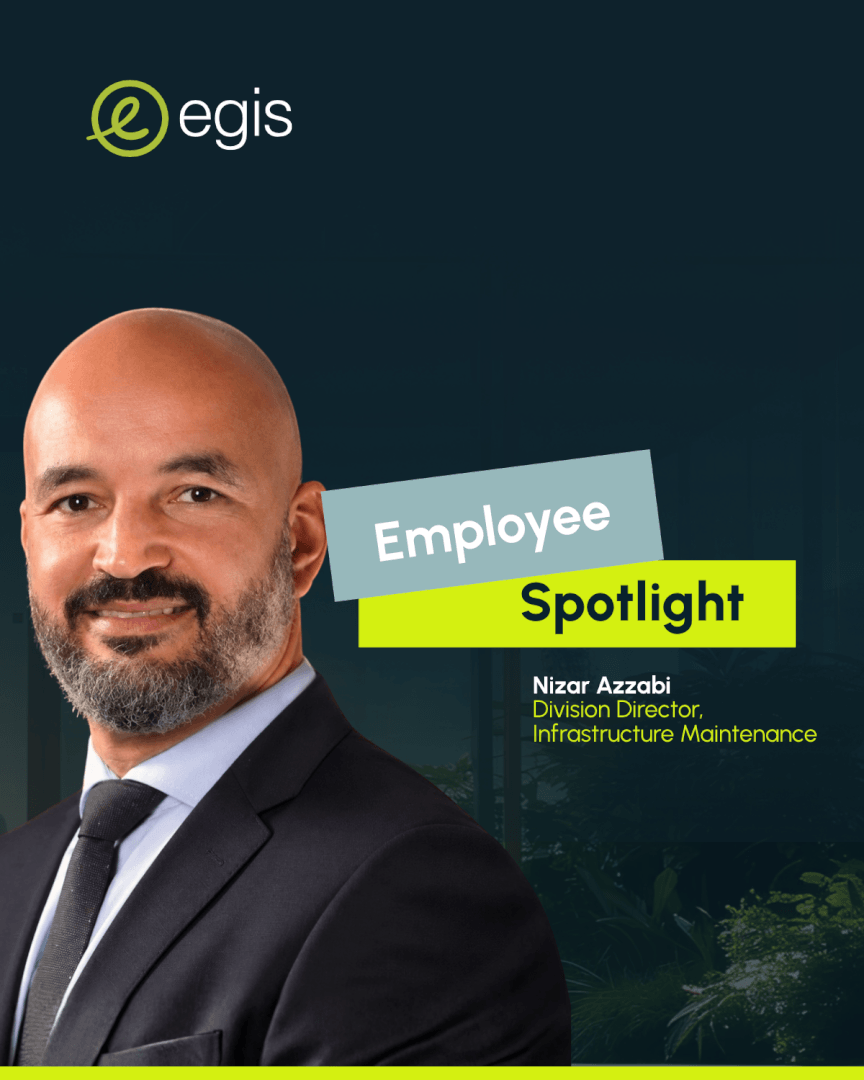
Can you tell us about your career journey? How did you move from starting out in France to working in the Middle East, and from rail projects to maintaining bridges, tunnels and underpasses? What made you choose maintenance?
I spent my first 30 years in France, where I trained as a civil engineer. I started on the road: seven years as a site engineer with Colas and Eiffage on roads and utilities, then two years in industry with Renault.
I wanted to return to construction, and in 2012 one offer stood out: a one-year contract with Alstom to design and build the Dubai Tram. One year became a life here. After the tram came 18 months with WSP on a tramway in Doha, then eight years back with Alstom, most of them on Route 2020, the Dubai Metro extension for Expo 2020.
Maintenance was a natural evolution: from building railways, to maintaining them, to maintaining road structures. For my last two years at Alstom, I was Deputy Maintenance Director of the Dubai Tram, the system I had helped build ten years earlier. From the tram to the metro and back to the tram, I worked with RTA at every step, and I learned how high their expectations are.
Then, in July 2024, I ran into Gurminder Singh Sagoo at the RTA reception. We had met at WSP in Qatar a decade before. That conversation opened the door to Egis. I started my career on roads, and I am back on them.
What does your team at Egis do day to day? What does it take to keep bridges, tunnels and pump stations in Dubai and the Northern Emirates working every day?
We maintain the structures entrusted to us across Dubai and the Northern Emirates: bridges, tunnels, underpasses, pump stations, stormwater systems and their equipment. Our clients are the government authorities responsible for road infrastructure, with RTA as our main client. Day to day, that means inspections, preventive maintenance and corrective maintenance.
A big part of the job is planning. We sit with our clients, agree the priorities against their budget, and build next year’s corrective maintenance plan in advance. For major works, such as replacing bearings or expansion joints, we survey on site, develop the design with specialised partners, review it, get the client’s approval, and only then order the materials.
Minor works are done by our own teams. Major works are done by our teams together with specialised subcontractors approved by our clients and the authorities.
What does it take? Anticipation, experience and daily discussion with our clients’ engineers. But above all, it takes motivated people, and we have more than 400 of them. The job is hard, on day shift, night shift, and sometimes both. People stay motivated when they feel respected, recognised and supported by their management. That is my first responsibility.
People usually only notice maintenance when something goes wrong. How do you show clients the value of your team’s work?
In our business, a good day is a day when nobody talks about us. So we cannot wait for an incident to prove our value. We make the invisible visible.
We report what we prevented, not only what we repaired: defects found early, response times, asset availability, safety performance. We put numbers and photos in front of the client every month.
And we stay available. Our clients can reach us 24/7, by call or WhatsApp, and there is always someone to respond at night.
How do the UAE’s weather conditions, like the April 2024 floods, extreme heat, humidity and coastal conditions, affect how infrastructure needs to be maintained?
The UAE is a hard environment for infrastructure. Summer heat stresses expansion joints, bearings, asphalt and every piece of electrical and mechanical equipment. Humidity and salt on the coast accelerate corrosion of steel and concrete. Sand blocks drains.
April 2024 reminded everyone that rain is rare here, but when it comes, it tests everything at once. The lesson for maintenance is clear: drainage and pumping systems must be cleaned, tested and ready before the rain, with emergency teams planned in advance.
In this climate, you maintain by anticipation. Waiting for the failure always costs more.
Most of your work happens on roads that stay open to traffic. How do you plan inspections and repairs while keeping traffic moving and your teams safe, especially in summer?
Almost everything we do is on roads open to traffic, so the first rule is that nobody improvises. Every intervention has a traffic management plan and a permit agreed with the authority. About 95% of our work is done at night, because we do not want to close a road during the day. Day work is for emergencies only. Crews are protected by proper signage, barriers and truck-mounted attenuators.
Summer adds a second risk: heat. Working at night helps, but summer nights stay hot and humid, so we organise water and rest breaks.
The road must stay open, but never at the price of someone’s safety. If the conditions are not safe, we stop and raise it to our safety team, who come back with a solution.
A lot of the UAE’s infrastructure was built around the same time and is getting older. What challenges do you expect in the coming years, and what should asset owners do now to prepare?
A large part of the UAE’s road network was built during the same period of fast growth. Many structures are now reaching the same age at the same time. Expansion joints, bearings, waterproofing and tunnel equipment will need major renewal in the coming years, while traffic keeps growing.
The risk is a wave of heavy repairs arriving together. Asset owners can prepare now with three things: reliable data on the real condition of each asset, a renewal plan over 10 to 20 years, and budgets that follow that plan.
The earlier you intervene, the less it costs and the less you disturb traffic.
Which technologies, such as sensors, drones, digital twins or predictive maintenance, are really making a difference in your work today? And which ones still need more time?
The technology that will make the biggest difference is not the most spectacular one. It is digital maintenance management: inspections captured on a tablet, defects recorded with photos and location, work orders tracked to closure. This is our next step. We are developing an asset management solution, planned to start next year.
Today, we have sensors on specific critical structures. They are useful there, not everywhere.
Digital twins and predictive maintenance need more time. They depend on years of clean, structured data, and the industry is still building that base. Technology does not replace the engineer on site. It helps them decide faster and better.
Your team includes engineers, supervisors and a large field workforce, often working at night and outdoors. What have you learned about leading people in this kind of work?
Three things.
First, be present. You cannot lead a night-shift workforce only from an office. Our engineers are on site every night, in shifts, and the management team joins them from time to time.
Second, respect. The technician working outdoors in August is the one who delivers the contract. He deserves clear instructions, fair conditions and to be listened to. Supervisors often know the solution before the engineers do. We listen to their requests, and we always do our maximum to improve their working conditions.
Third, keep your good people. Experience is our main asset. My priority is to keep experienced, motivated people in the team and give them room to grow.
You recently won your first boxing fight after only six months of training. What did this experience teach you about discipline and teamwork, and how has it influenced the way you lead at work?
A year ago, I watched a friend fight at a White Collar event and decided I would do it too. I had never boxed. After six months of preparation, I stepped into the ring at Spartans White Collar 13, in the heavyweight category, and won by unanimous decision. Together, the 18 fighters raised around AED 400,000 for orphan care in Gaza through Gulf for Good. My own campaign raised AED 21,000.
Discipline first: there is no shortcut. The fight is won in the months before, in the sessions nobody sees. Work is the same. Results come from preparation, not from a last-minute effort.
Teamwork second. You are alone in the ring, but nobody gets there alone. I had two coaches, Yannick and Jake, and my family and supporters behind me. I also had to accept being a beginner again, and to listen.
That changed how I lead. I prepare more, I listen more, and I stay calm when the pressure comes. In the ring as on a project, you will take hits. What matters is how you react.
If you could change one thing about how infrastructure maintenance is planned or funded in the region, what would it be and why?
I would plan and fund maintenance from the design stage, over the whole life of the asset. Across our industry, construction gets the long-term vision and maintenance often gets an annual budget.
Multi-year, condition-based programmes give asset owners better value: fewer emergencies, less disruption for road users, longer asset life. The region has built world-class infrastructure. Long-term maintenance planning is how we keep it world-class.