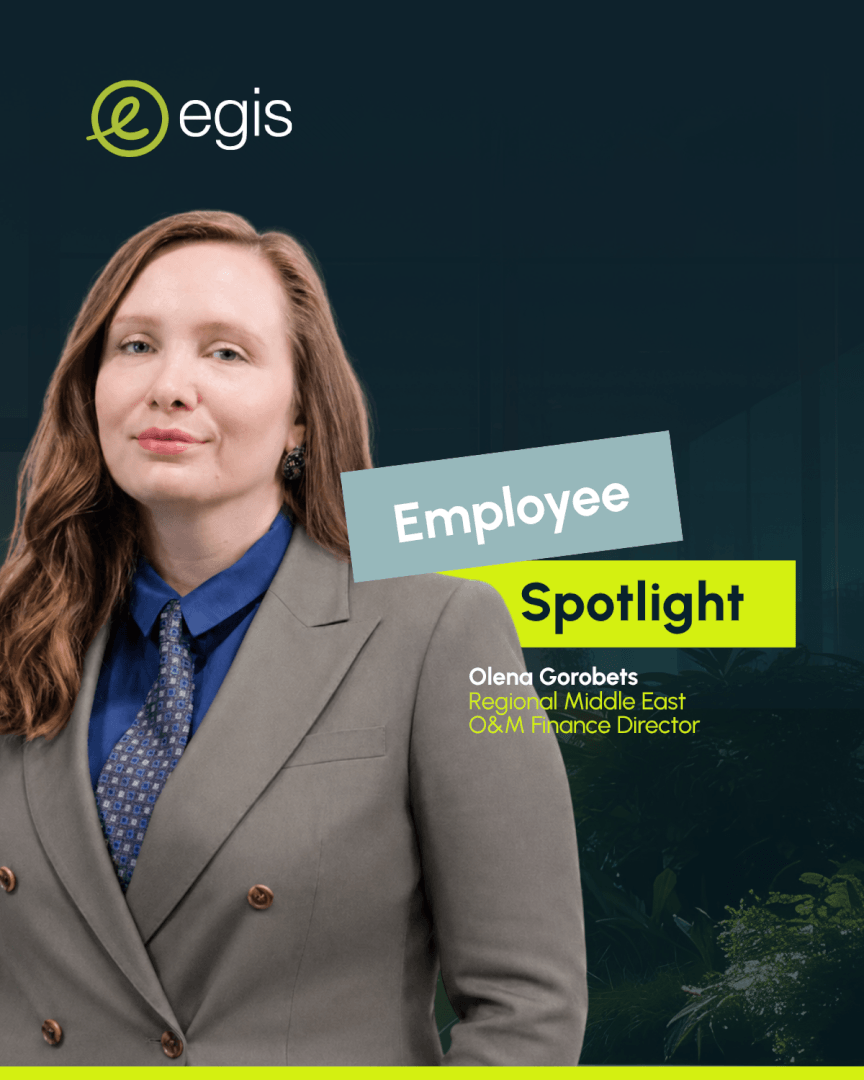
Let’s go back to 2021, when you first joined Egis as a Financial Controller in the UAE. What did that chapter look like, and did you ever imagine it would lead you to where you are today?
In the long term yes. I had always been ambitious. But within a year? Definitely not. I joined Egis from another business where I had already been a Finance Director. Moving into a Financial Controller role was a conscious decision: I wanted a new industry, an international environment, and a different scale of business. The strategy was quite sensible: settle in, learn how things worked, and progress steadily from there.
The corporate world, naturally, had a different plan. Within a year, Egis acquired the business I had joined, placing me right in the middle of a major integration process. My line manager moved to the head office, workflows were changing on the go, and I had to take responsibility for the finance function of the construction & maintenance business in the region very quickly.
Still, that controlled chaos shaped me. I learnt that we almost never feel 100% ready for the next level. The responsibility comes first, and only afterwards do you have that moment of “Right. Apparently, I can actually do this.”
You’ve worked across construction and now Operations & Maintenance. What did moving between those two worlds teach you about how projects really work behind the scenes?
Deep down, I am an incurable romantic when it comes to construction. Watching a real asset emerge from drawings, concrete, calculations, and the work of so many people still feels a little like magic to me.
But construction and O&M require very different ways of thinking. In construction, at some point, you can actually say, “We’re finished.” In O&M, that is a rather optimistic concept.
Here, you think in years, sometimes decades. Financially, you move from project margin and milestones to long-term cash flow, cost indexation, risks, resource efficiency, and the sustainability of the contract. Operations, Commercial, Procurement, and Finance all need to move in sync.
Very often, a problem that eventually looks “financial” actually started operationally much earlier. The sooner Finance understands what is happening inside the project, the more time the business has to do something about it.
Finance is often seen as the team that comes in when it’s time to talk numbers, but on a major project, your role starts much earlier than that. What does Finance actually bring to a project that people might not see?
Finance is still sometimes mistaken for a more advanced version of accounting expected to make sure salaries are paid, invoices are processed, and, ideally, no unnecessary questions are asked.
Unfortunately, we tend to struggle with the last part.
On a major project, Finance should be involved long before there is anything to report. We challenge the assumptions behind the project: Is the margin realistic? What happens to cash if things do not go to plan? When will we actually get paid? What risks are we taking today that may only become visible years later?
This is where Finance creates the most value not by doing “financial archaeology” to explain past losses, but by seeing risks early enough to still change the outcome.
O&M projects can run for years, so success isn’t just about delivering something and moving on. From your side of the table, what does a healthy, successful O&M project actually look like?
For me, a healthy project is, above all, a predictable project although absolute predictability in our business exists mostly in beautiful presentations. So, by predictability, I do not mean the absence of risk. I mean the absence of unpleasant surprises.
Risks need to be identified early, quantified, and actively managed. Margins need to be realistic, billing needs to happen on time, and receivables need to be collected.
And profitability and cash may know each other very well, but they are still two different characters. A project can look excellent on paper while putting serious pressure on cash flow.
But project health is not only about numbers. It is also about communication and ownership. Finance, Operations, and Commercial need to work as one team while being very clear about their own responsibilities. Problems should not travel between functions looking for someone to blame. They should be raised early enough for the team to still do something about them.
So, my favourite financial surprise is the one we knew about six months ago.
Is there a project, contract, or moment at Egis that really stayed with you maybe because it was challenging, changed the way you work, or simply made you think, “This is why I do what I do”?
For me, it has been my entire journey at Egis. Whenever major changes happen, you cannot put an operating business on hold and say, “Sorry, please come back in six months.” The day-to-day work continues while processes, systems, and corporate requirements are all changing around you.
It changed the way I respond to difficult situations. Earlier in my career, when something serious happened, my first internal reaction was, “What do we do?” Now it is, “How much time do we have? Good. Let’s work it out.”
The problems, unfortunately, did not get smaller. They just got more expensive.
What changed was my own sense of scale. To me, that is one of the clearest signs of professional growth: not the absence of difficult situations, but the ability to maintain clarity of thought when they happen.
Your career has taken you across different countries, industries, and roles, with moments of starting over and finding your voice along the way. What parts of that journey still influence the way you lead today?
Probably the biggest influence on my leadership style has been having to enter completely new environments several times and find my place again a different country, a different industry, a different role, a different scale of business.
That experience quickly removes the belief that there is only one “right” way of doing things. You learn to adapt, ask questions, listen to people who know something better than you do, and still be comfortable making decisions. It has also shaped the way I lead my team.
My approach to leadership depends on the context. In times of high pressure, I’m deeply involved and working right next to my team. In calmer times, I focus on empowering them. I encourage independence and open dialogue, expecting everyone to take full ownership of their scope. Ultimately, the best team is not one that needs its leader to make every decision, but one that has the confidence and clarity to act autonomously.
We often spend the early years of our careers trying to become someone, only to realise later which parts of ourselves were worth holding onto. What’s one part of the younger Olena that you’re glad never changed?
Character. Professional skills can be developed, knowledge constantly evolves, and experience inevitably comes with time. But character determines what you do when your beautiful Plan A falls apart.
I am glad I never lost that inner stubbornness the ability to keep going when something does not work the first, second, or tenth time. With age, it has simply become less impulsive and, hopefully, a little more strategic.
The willingness to take responsibility and see things through is still one of my foundations. There is, however, one thing I would definitely explain to my younger self: “Taking responsibility” and “carrying absolutely everything on your own shoulders, burning yourself out, and trying to save the world single-handedly” are two fundamentally different sports. It is a shame that part does not usually come with the instructions.
We’ve looked back quite a bit, so let’s look ahead for a moment: what’s something you’re really looking forward to next?
What excites me most is broadening the scope of what I can influence.
Finance will always be my professional foundation, but I no longer define my role purely through finance. A large part of my work today is already about negotiations, people, operations, and decisions where there is rarely one perfectly correct answer.
Sometimes you smooth things over. Sometimes you challenge. And sometimes your job is simply to ask the question that makes the room go slightly quieter. I genuinely enjoy that part.
So, for me, the next step is not simply moving further up within Finance. It is becoming broader as a business leader understanding the business well enough to contribute beyond my own function and help shape where it goes next. Technology, AI, and sustainability are interesting to me through that lens because they are changing the choices available to us. I think that is what I am most curious about next: not simply becoming a better Finance Director, but seeing how much broader the role can become.

.png?v=40921b089dd4844c3f3740d05beab7ba)