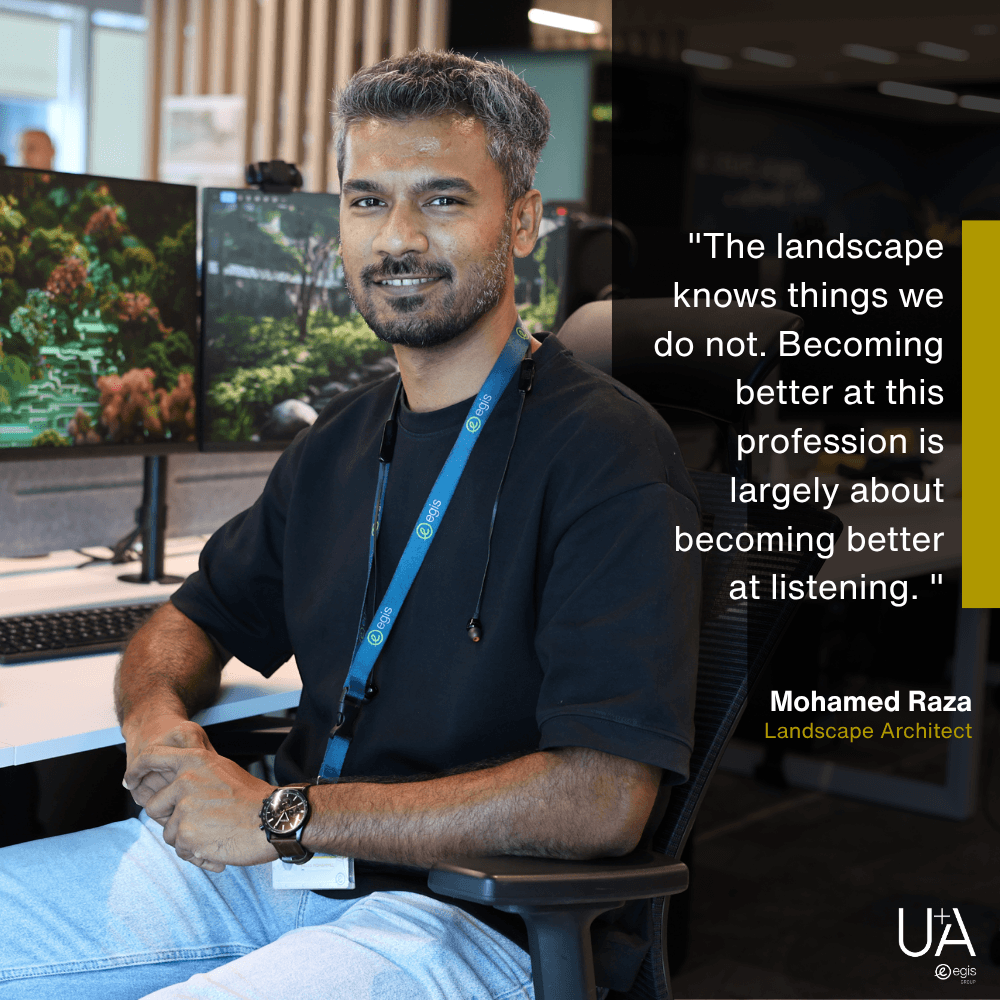
The Landscapes We Inherit: The Wild Things We Cannot Design with Mohamed Raza
Raza Mohamed, BLA (Hons), is a Landscape Architect and Planner with 10 years of experience designing and transforming meaningful spaces that balance beauty, function, and environmental responsibility across urban, rural, and built environments. His expertise spans master planning, site analysis, and sustainable construction, with a specialization in ecological design that prioritizes biodiversity, water-sensitive planning, and regenerative landscapes. Grounded in both theory and practice, Raza integrates climate-resilient, context-sensitive solutions that harmonize with local ecosystems, reflecting his commitment to restoring ecological integrity and enriching human experience while safeguarding the environment for future generations.
Where did your fascination with landscape begin?
My fascination with landscape began long before I knew there was a profession called landscape architecture. I grew up in the Central Highlands of Sri Lanka, surrounded by a traditional Kandyan home garden complex, multi-layered tropical gardens that had evolved over generations almost like miniature ecosystems. When I was eight or nine, I created what I proudly considered my own insectarium, or “bug zoo,” in our garden. Beetles, caterpillars, millipedes, spiders- basically, if it moved slowly enough for me to catch it, there was a good chance it ended up temporarily living in one of my jars or boxes. At the time, it was simply childhood curiosity. Looking back, I realise I was already trying to understand where things lived, what they depended on, and how one garden could hold an entire world.
What fascinates me now is that nobody around me called any of this “ecological design.” They simply knew how the landscape worked. Mosquitoes were not automatically answered with chemicals; people used particular plants, managed water carefully, and encouraged predators such as dragonflies. They knew which snakes were dangerous and which were useful; a rat snake in the garden was welcome because it meant fewer rats near the house. There was an instinctive understanding that even the creatures we disliked had a place in a larger hierarchy. I grew up thinking this was simply how people lived. It was only midway through university that I realised many of the things that had fascinated me since childhood had a name, and that perhaps I had been finding my way towards landscape architecture all along.
How has moving between Sri Lanka, the UAE and Saudi Arabia changed the way you understand landscape?
I always knew intellectually that landscapes were diverse, but I don't think I truly felt that until I moved from tropical Sri Lanka to the Arabian desert. My first reaction was almost shock. I came from a place where life practically competes for your attention, trees growing over trees, insects everywhere, birds, water, vines, layers upon layers of green. Then suddenly I was looking at enormous expanses of sand and rock. To my tropical eyes, it initially felt empty.
But the longer I lived here, the more I realised that the desert is not empty at all. It simply makes you work harder to see its life. In a tropical landscape, life stands in front of you; in the desert, you often notice first the things that make life possible: the shadow of a rock, a depression collecting water, a shrub creating a cooler microclimate, or the extraordinary transformation that can follow a short rainfall. Interestingly, I also encountered familiar plants such as Azadirachta and Delonix, species I knew from Sri Lanka, growing in an entirely different environmental story. That taught me something important: recognising a plant is not the same as understanding a landscape. Whether it is rainforest or desert, every landscape is creating a sanctuary for life; it just speaks a different ecological language.
You describe landscape architecture as both a science and an art. When those two sides disagree, which one wins?
The name itself almost explains the contradiction. You could say landscape is the science and architecture is the art, and on another day, argue exactly the opposite. That is what I find fascinating about the profession. The two do not sit politely beside each other and take turns. Landscape architecture is the art of science and the science of art. A decision about how a place should feel is simultaneously a decision about soil, water, climate, growth and time.
Ideally, neither side wins. A good landscape is successful precisely because you cannot tell where science ends, and art begins. But humans have a tendency to force art to win; we want the perfect image, the dramatic geometry, the instant photograph. Nature is less interested in our presentation boards. Choose a tree purely because its silhouette looks beautiful, and the soil may correct your decision three years later. Draw water flowing one way, and gravity may have another opinion. Science eventually wins because the site has the final vote. And if we continuously fight that reality with irrigation, replacement, and maintenance, the landscape may survive, but it loses something essential. It is being kept alive rather than living.
Has working with something you cannot completely control changed the way you approach design?
I would almost turn the question around: it isn't that working with change altered my approach; change is one of the materials we design with. Landscape architecture exists because this part of the built environment refuses to remain still. A building is often at its most complete on opening day and is maintained against ageing from then onwards. A landscape, strangely, can open on its worst day. The trees are small, the planting has not knitted together, habitats are just beginning to form. Everything that follows is the design slowly arriving.
So we are never really drawing a finished picture. We are establishing conditions and setting something in motion. We think about what the tree might become in ten or twenty years, what happens when roots expand, how shade moves, how people may appropriate a space differently from what we imagined. Control was never really available to us; influence is. The landscapes that struggle are often the ones designed to freeze one perfect moment. The ones that succeed are allowed to grow beyond the drawing.
What is the difference between a landscape that looks natural and one that actually functions as an ecosystem?
I think we often confuse greenery with nature. There is such a strong association between green and environmental value that we are sometimes willing to install artificial greenery just to achieve the appearance. But a landscape can be incredibly green and still depend on enormous amounts of irrigation, fertiliser, replacement and maintenance simply to remain that way. It may look alive without really behaving like a living system.
For me, ecological integrity begins when we allow the ecology of a place to define its beauty rather than imposing somebody else's image of beauty onto it. Imagine a meadow of Aerva javanica moving in the desert wind, punctuated by native acacia trees. It may not look like the conventional lush garden, but it belongs there. It survives with little intervention, shelters other species, responds to the seasons, and becomes part of a larger system. I find that far more beautiful than forcing a tropical image onto a desert. A landscape does not have to look green to be alive.
When did you realise the most successful intervention might be the least visible?
There is a particular instinct designers have when we arrive at a site: What can I put here? A path, a pavilion, a planting gesture, something that clearly demonstrates that design has happened. But I have increasingly found that the longer you spend understanding a site, the quieter your decisions sometimes become. You realise that an existing patch of vegetation has already solved a problem you were about to solve from scratch. A natural depression already knows where the water wants to go. Existing ground may be doing more ecological work than the beautiful new surface you were planning to replace it with.
When did you realise the most successful intervention might be the least visible?
There is a particular instinct designers have when we arrive at a site: What can I put here? A path, a pavilion, a planting gesture, something that clearly demonstrates that design has happened. But I have increasingly found that the longer you spend understanding a site, the quieter your decisions sometimes become. You realise that an existing patch of vegetation has already solved a problem you were about to solve from scratch. A natural depression already knows where the water wants to go. Existing ground may be doing more ecological work than the beautiful new surface you were planning to replace it with.
That changed how I think about authorship. Maybe the landscape does not need to announce who designed it. If somebody experiences cooler air, sits beneath good shade, hears more birds, watches water disappear naturally into the ground, or sees plants regenerating without ever thinking about the designer, that is not a failure of design. It may actually be its highest success. Sometimes our job is not to write a new story across the site, but to recognise the story already being told and resist interrupting it.
Has the profession changed the way you experience ordinary places?
The funniest part is that I can no longer simply see a tree as a tree. I might be walking somewhere with friends and realise that we are looking at completely different worlds. They see “a nice tree.” My brain immediately goes, Azadirachta indica. Another shrub appears, and the scientific name follows. It isn't deliberate anymore; unfortunately, there is no off switch. A roadside, somebody's front garden, even a car park can become an unsolicited botanical identification exercise in my head.
But then the second layer starts. I notice where rainwater is running from the stain it leaves on a kerb. I notice a tree struggling because its roots have been given a tiny square of soil surrounded by paving. I wonder why people always choose one side of a street and realise it is probably shade or wind. Even silence becomes information; sometimes a green space with no insects or birds tells you more than its planting does. Years ago, I might have walked past a hedge and simply seen a hedge. Now I might see a monoculture and wonder what else could have lived there. It occasionally makes relaxing in a landscape difficult, because part of your brain is always working, but discovering a place that is genuinely functioning has become one of the great pleasures of the profession.
Has your definition of a “successful” landscape changed?
Definitely. Earlier in my career, I think I was naturally more attracted to the immediate image of a landscape, the composition, the geometry, the planting arrangement, how strong the concept looked when everything was newly completed. There is nothing wrong with that; beauty and experience are fundamental to what we do. But experience gradually teaches you that opening day is a very poor moment to judge a landscape.
Today, I am much more interested in what happens afterwards. Does the landscape become better after five years rather than more exhausted? Can plants reproduce and adapt rather than constantly being replaced? Do people start using a space in ways we never predicted? Does it create shade, habitat and comfort without demanding endless intervention? I have also become more comfortable with imperfection. Seasonal change, spontaneous vegetation and a little wildness once might have looked like something that needed correcting; now I sometimes see them as evidence that the landscape has begun to develop a life of its own. My definition of success has shifted from “Does it look exactly as we designed it?” to “Can it eventually thrive without needing us?”
What would you want a young landscape architect to understand about their relationship with nature?
I would tell them not to begin by asking, “What can I add here?” Begin by asking, “What is already happening here?” Nature is never an empty canvas. Even a disturbed construction site, an apparently lifeless desert plot, or an abandoned piece of land already has water movement, microorganisms, seeds, memories, limits, and opportunities. The more carefully you observe those things, the less urgently you feel the need to impose yourself on the place.
What I have learned personally is that our relationship with nature should be closer to collaboration than control. We can guide it, repair damaged systems and create better starting conditions, but we also need the humility to step aside. Some of the strongest lessons of my career have not come from drawing plans. They have come from watching a plant survive somewhere I thought it couldn't, seeing water find its own route regardless of the line on a drawing, or watching an ecosystem organise itself without waiting for our permission. The landscape knows things we do not. Becoming better at this profession is largely about becoming better at listening.
Receive articles like this
Related roles
Salary
-
Location
Dubai
Experience level
Entry-Level
Location
Dubai
Job Family
Architecture
Type of Contract
Permanent Contract
Brands
U+A
Description
We are seeking a passionate and creative Emirati Graduate Architect to join our Architecture Team. The ideal candidate will collaborate closely with our talented team of designers to develop innovativ
Reference
1fe4dd4f-4f9e-4f0a-b010-1ceda4a316d0
Expiry Date
01/01/0001
Author
Lisa SmithAuthor
Lisa SmithSalary
-
Location
Dubai
Experience level
Mid-Senior Level
Location
Dubai
Job Family
Architecture
Type of Contract
Permanent Contract
Brands
U+A
Description
Senior Structural Engineer (Buildings Project):We are seeking a highly skilled and experienced Site Supervision Senior Structural Engineer to join our team in Dubai, United Arab Emirates. As a Senior
Reference
ea528305-1702-44f9-b604-2306c56ef8bf
Expiry Date
01/01/0001
Author
Lisa SmithAuthor
Lisa SmithSalary
-
Location
Dubai
Experience level
Mid-Senior Level
Location
Dubai
Job Family
Architecture
Type of Contract
Permanent Contract
Brands
U+A
Description
We are seeking a detail-oriented and analytical Mechanical Inspector - Site to join our team in Dubai, United Arab Emirates. In this role, you will be responsible for conducting thorough mechanical in
Reference
898a7747-8b54-4f9a-8abe-6db258545597
Expiry Date
01/01/0001
Author
Lisa SmithAuthor
Lisa SmithSalary
-
Location
Dubai
Experience level
Mid-Senior Level
Location
Dubai
Job Family
Architecture
Type of Contract
Permanent Contract
Brands
U+A
Description
We are seeking a detail-oriented and organized Assistant Resident Engineer to join our team in Abu Dhabi, United Arab Emirates. In this role, you will work alongside the Resident Engineer to oversee c
Reference
e7583116-98dc-430c-851a-466921846c8d
Expiry Date
01/01/0001
Author
Lisa SmithAuthor
Lisa SmithSalary
-
Location
Dubai
Experience level
Mid-Senior Level
Location
Dubai
Job Family
Architecture
Type of Contract
Permanent Contract
Brands
U+A
Description
We are looking for an enthusiastic and highly talented Junior Master Planner with 2-5 years of professional experience to support with small to large-scale master planning and urban design projects. T
Reference
b83f755a-42f7-479e-a0c9-95bb58d4e98e
Expiry Date
01/01/0001
Author
Lisa SmithAuthor
Lisa SmithSalary
-
Location
Dubai
Experience level
Mid-Senior Level
Location
Dubai
Job Family
Architecture
Type of Contract
Permanent Contract
Brands
U+A
Description
We are looking for a motivated and technically strong Master Planner with 5–7 years of professional experience to support master planning and urban design projects. The role involves developing planni
Reference
ebb80076-e3fb-4377-b621-ba540c78b6a2
Expiry Date
01/01/0001
Author
Lisa SmithAuthor
Lisa SmithSalary
-
Location
Dubai
Experience level
Mid-Senior Level
Location
Dubai
Job Family
Architecture
Type of Contract
Permanent Contract
Brands
U+A
Description
We are seeking a detail-oriented and analytical Senior Planning Engineer to join our team in Dubai, United Arab Emirates. As a Site Planning Engineer, you will play a crucial role in ensuring the effi
Reference
7787ac69-02fc-49b8-a415-90452ef385ab
Expiry Date
01/01/0001
Author
Lisa SmithAuthor
Lisa SmithSalary
-
Location
Dubai
Experience level
Mid-Senior Level
Location
Dubai
Job Family
Architecture
Type of Contract
Permanent Contract
Brands
U+A
Description
The Architect Site role is a critical position responsible for ensuring the highest standards of architectural integrity and project compliance. The successful candidate will be entrusted with the fol
Reference
3857c379-5f74-4691-9775-e5c4ce6b7c14
Expiry Date
01/01/0001
Author
Lisa SmithAuthor
Lisa SmithSalary
-
Location
Abu Dhabi
Experience level
Mid-Senior Level
Location
Abu Dhabi
Job Family
Site Supervision
Type of Contract
Permanent Contract
Brands
U+A
Description
Structural Inspector (Buildings Project):We are seeking a competent and detail-oriented Structural Inspector to join our supervision team in Abu Dhabi, United Arab Emirates. The role involves ensuring
Reference
b757bfcd-6d45-45ba-90f6-366100bad443
Expiry Date
01/01/0001
Author
Lisa SmithAuthor
Lisa SmithSalary
-
Location
Dubai
Experience level
Mid-Senior Level
Location
Dubai
Job Family
Architecture
Type of Contract
Permanent Contract
Brands
U+A
Description
Oversee and monitor architectural works to ensure conformance with contract documents and the procedures manual.Review and process all architectural technical submittals.Address RFIs related to archit
Reference
ca79e988-5a27-47e9-a454-8e4aba188258
Expiry Date
01/01/0001
Author
Lisa SmithAuthor
Lisa SmithRelated Articles
Teaser
ArticleContent Type
TestimoniesPublish date
08/18/2026
Summary
The Machine That Calculates and the Machine That GuessesWritten by Martin Pretorius, Senior Architect at U+AWhen people talk about AI in architecture, they usually start with images.
by
Sofia Filipchenkova
Teaser
InterviewContent Type
TestimoniesPublish date
08/14/2026
Summary
Learning Across Cities: What Tehran, London, and Dubai Taught Mamali About Architecture Mamali is a Project Director at U+A with excellent team-leading and communication skill
by
Sofia Filipchenkova
Teaser
InterviewContent Type
TestimoniesPublish date
07/22/2026
Summary
Designing for the Senses with Hala Mohamed: The Relationship Between Materiality, Memory, and Emotion Hala Mohamed is a Senior FF&E Designer at U+A with experience across hosp
by
Sofia Filipchenkova
Teaser
ArticleContent Type
TestimoniesPublish date
07/06/2026
Summary
Built for Today, Designed for Tomorrow Sustainability in architecture today is no longer an added value; it is a fundamental responsibility. As the built environment continues t
by
Sofia Filipchenkova
Teaser
Tst Company updateContent Type
TestimoniesPublish date
06/11/2026
Summary
Cobus Terblanche: A Human Centric Processes: The Value of Collaboration in a Profession Defined by Constant Change, Conflicting Demands, and High-Stakes Decisions Cobus Terbla
by
Sofia Filipchenkova
Teaser
ArticleContent Type
TestimoniesPublish date
06/11/2026
Summary
Designing with Purpose: The Role of Materiality and Color in Design Each successful interior space is a blend of the right materials with careful planning. Materials are
by
Sofia Filipchenkova
Teaser
InterviewContent Type
TestimoniesPublish date
05/14/2026
Summary
The Subtle Art of Making Spaces Feel Effortless with Zoya Khan Zoya Khan is an Interior Designer at U+A, bringing a strong architectural foundation and over four years of expe
by
Sofia Filipchenkova
Teaser
ArticleContent Type
TestimoniesPublish date
05/04/2026
Summary
Built to Feel: The Emerging Science of Neuroarchitecture Think of a place you often visit that instantly makes you feel happy or at ease the second you enter it. Now thi
by
Sofia Filipchenkova
Teaser
InterviewContent Type
TestimoniesPublish date
04/23/2026
Summary
Reading Cities Like Stories: How Emel Elfakir Uses Master Planning to Script Everyday Rituals Emel Elfakir is an Associate Master Planner at U+A with over twelve years of expe
by
Sofia Filipchenkova
Teaser
InterviewContent Type
TestimoniesPublish date
04/02/2026
Summary
Growth Code: How Ahmed Samy's Daily Rituals Forged Unbreakable Focus Ahmed Samy is an Associate Director at U+A with 19 years of experience delivering UAE architec
by
Sofia Filipchenkova
Your perfect role awaits at Egis: backed by expertise, driven by passion!
With decades of industry expertise, Egis is dedicated to helping you find your ideal role.
Whether you're an experienced professional or new to the field, our team is here to support your journey, providing guidance every step of the way.
Discover opportunities that match your passion and skills with Egis.
Recently viewed jobs